

Common Mistakes
Building strong glutes requires more than just feeling the burn. Many programs miss the fundamentals that actually drive progress. Here are some of the most common mistakes I see.
Not Training with Intention
Walking into the gym and “just doing legs” isn’t the same as training glutes. It requires intention.
If you want your glutes to grow, your training needs to reflect that. Exercise selection, stance, tempo, and execution all matter.
Random workouts, cardio disguised as lifting, rushed reps, and ignoring mind-muscle connection won't build shape or strength.
If you are not actively thinking about where the tension is going, how you are controlling the movement, and how you are progressing over time, you are leaving results on the table.
Glutes do not grow by accident. They grow from focused, intentional work.
Train with purpose. Not just effort.
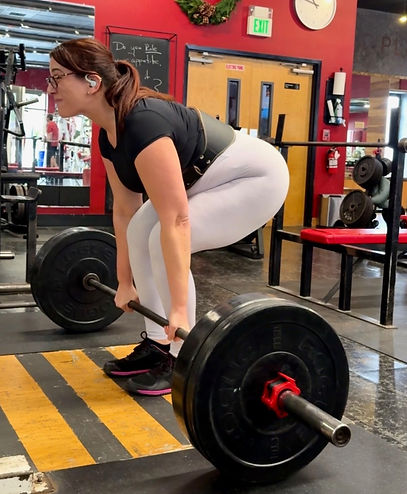
Not Training Close Enough to Failure
This is one of the biggest factors killing your gains.
If you finish every set feeling like you could have done five more reps, you are capping your own potential.
Growth happens when the muscle is forced to adapt. That does not mean sloppy form or ego lifting. It means training within 0-3 reps of true failure on your working sets, especially your primary movements.
It means:
• Choosing loads that challenge you
• Maintaining strong technique
• Pushing through discomfort safely
• Tracking progression over time
Effective glute training should feel demanding. You should be focused. You should be working.
And if you are not making at least one questionable facial expression by the end of a hard set, you probably are not close enough to failure.
If it never feels hard, it likely is not stimulating growth. Comfort does not build glutes. Effort does.

Beginners may not need to train to failure immediately, but they should still be working at a challenging intensity.
Not Utilizing the Principle of Progressive Overload
If you are lifting the same weight, for the same reps, doing the same exercises week after week… your body has no reason to change. Muscle growth requires progressive overloading, or doing more over time.
There are many ways to progressively overload, including:
• Increasing weight or increasing reps
• Improving range of motion
• Slowing tempo
• Improving control and execution
• Adding volume strategically
But something must progress. Your body adapts to what it is repeatedly exposed to. If the stimulus never increases, adaptation stops.
This is why random workouts and “doing what feels good” often lead to plateaus.
Glute development is not accidental. It's the result of intentional progression over time.
Track your lifts.
Challenge the load.
Earn the growth.

Relying on Light Band Work
Banded kickbacks, abductions, and lateral walks absolutely have their place. But light band exercises alone are not enough to build meaningful glute hypertrophy.
They are great for activation, warm-ups, burnouts, pump days, and targeted accessory work. What they are not is a replacement for progressive loading.
Glutes are large, powerful muscles. They respond to mechanical tension and progressive overload, not just constant light resistance. If your entire program revolves around mini bands and high-rep pulses, you are likely missing the stimulus required for real growth.
Bands support the work. They are not the foundation of it.
Load builds muscle. Progression builds shape.

Poor Hip Mechanics
If your lower back or hamstrings are taking over during hinges and deadlifts, your glutes are likely not doing their job.
A proper hinge is a hip-driven movement. If you are rounding, overextending, or simply moving the bar up and down without true hip control, you are missing the point of the exercise.
Alignment matters. Bracing matters.
Full, controlled hip extension matters.
If you feel every hinge in your low back and never in your glutes, it is a mechanics issue, not a “weak glute” issue.
Glutes respond to tension. Tension requires proper positioning. Master the movement before you load it.

Too Much Quad Dominance
Squats and lunges are not automatically “glute exercises.”
Without intentional setup, they can easily turn into quad-dominant movements.
Your stance width, foot position, shin angle, and torso angle all influence which muscles are doing the majority of the work. If your knees are driving excessively forward and your torso stays very upright, you are likely biasing quads more than glutes.
That is not wrong. But if your goal is glute development, it may not be optimal. Small adjustments can completely change the stimulus.
Glute growth is not about doing more squats.
It is about performing them with intention.

Not Getting Enough Rest and Recovery

Rest is not optional. It's part of the program. Muscles are broken down during training, but they grow during recovery. If you are constantly pushing hard without allowing adequate recovery, progress will eventually stall.
Sleep, nutrition, stress management, and intelligent programming all matter. Rest between sets and recovery between sessions matter just as much.
If you rush every set with barely enough time to breathe, you limit how much weight you can lift and how much tension you can create. Short rest periods have their place depending on the goal. But when training for strength and muscle growth, adequate rest allows you to show up stronger for the next set.
Stronger sets lead to better results.
Training hard is important. Recovering well is essential.
Glute training is not about doing more. It is about doing the right things consistently and progressively.
