
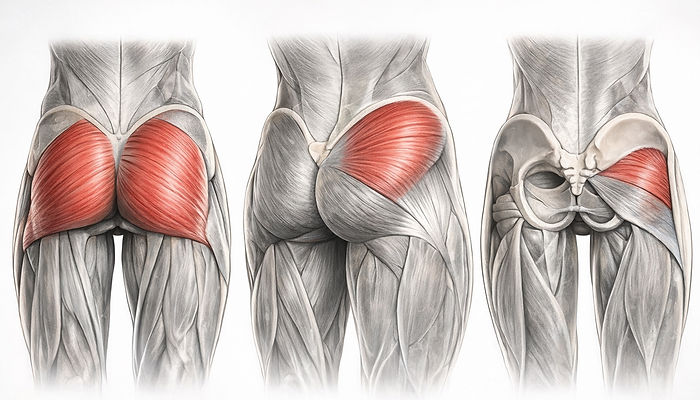
The Glute Muscles
When people talk about “glutes,” they’re usually thinking of one muscle. In reality, the glutes are made up of three distinct muscles that work together to support, stabilize, and move the hip joint. Understanding their individual roles allows you to train them with purpose, not just randomly.
Gluteus Maximus
The largest and most powerful of the three.
Primary roles:
• Hip extension
• External rotation
• Force production
The gluteus maximus drives powerful movements like deadlifts, hip thrusts, squats, sprinting, and climbing stairs.
It is responsible for generating hip extension force, driving the hips forward under load.
Strong glute max development improves athletic performance and reduces excessive strain on the lower back by ensuring the hips, not the spine, absorb heavy forces.

Gluteus Medius
Often overlooked, but critically important.
Primary role:
Often overlooked, but critically important.
Primary roles:
• Pelvic stabilization
• Hip abduction
• Knee alignment and stability
The glute medius works hardest during single-leg tasks like walking, lunging, step-ups, and running.
It prevents the pelvis from dropping and the knees from collapsing inward.
Weak glute medius function is commonly associated with knee discomfort, hip instability, and poor lower-body mechanics.

Gluteus Minimus
Often overlooked, but critically important.
Primary role:
The smallest and deepest of the three.
Primary roles:
• Hip stabilization
• Hip abduction
• Assists in rotation
• Joint control
The glute minimus works alongside the glute medius to stabilize the hip joint.
It does not create large visible movement, but it plays a crucial role in maintaining joint integrity, alignment, and balance.

Why This Matters for Training
If your program only focuses on heavy hip thrusts or glute bridges, you are primarily targeting glute max.
Balanced glute development requires:
• Heavy compound lifts
• Unilateral work, (or single-leg training)
• Lateral movement patterns and abduction work
• Stability-focused exercises
• Training through multiple planes of motion
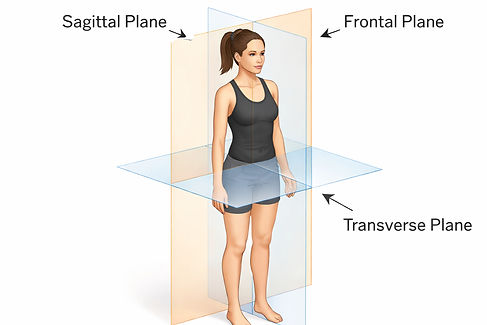
Strong glutes are not just built by loading the bar. They are built by training all three muscles with intention.
